
Cambria General Contractor in Mesquite: A Homeowner’s Guide
Cambria’s lifetime warranty covers manufacturing defects, not installation damage. That distinction matters more than most homeowners realize. A seam placed over an unsupported span, a common shortcut on kitchen islands, can produce a crack within two years that Cambria will correctly attribute to installation rather than material. The homeowner is left with no recourse, a cracked countertop, and a warranty card that doesn’t help. If you’d rather not spend your evenings reading slab specifications, call (833) 620-6606 and we’ll walk you through what a compliant Cambria install actually requires in Mesquite.
Key Takeaways:
- Cambria quartz is engineered stone, and its warranty hinges on installation to spec, including substrate, support, and seam placement.
- Seam location should be documented in your written scope before templating begins.
- Mesquite’s desert temperature swings put more stress on seams than cooler climates do, which makes proper caulk joints essential.
- A verbal quote usually omits templating, support structure, and seam documentation. A written price should not.
What Does Cambria’s Warranty Actually Require From Your Contractor?
Cambria’s transferable lifetime limited warranty covers the slab itself against manufacturing defects. What it does not cover is damage caused by improper installation, and the warranty terms spell out the installation conditions a contractor must meet. In practical terms, that means your contractor needs to read the substrate and support specifications before any slab is templated, not after it arrives on site.
The core requirements look like this:
- Substrate flatness. Cambria specifies a flat substrate under the slab. A cabinet run that’s out of level by a quarter inch over eight feet will telegraph through a quartz surface once it’s set.
- Full perimeter support. The slab must be supported along its full perimeter and any cantilevered overhang beyond a certain distance requires corbels or steel. Walking into a kitchen and seeing a two-foot overhang floating on nothing is the first thing we check.
- Cabinet rigidity. Base cabinets need to be anchored and shimmed before templating, because Cambria is templated to the cabinet as it actually sits. A cabinet that shifts after templating means a countertop that doesn’t fit.
- No cutouts near seams. Sink and cooktop cutouts weaken the slab locally. Seams placed near a cutout create a stress point that can fail.
None of this is exotic. It’s just rarely discussed before the contract is signed. In Mesquite, where a lot of homes are single-story ranch plans with long cabinet runs, substrate flatness over a twelve-foot run is where we see the most shortcuts. If your contractor can’t tell you the flatness tolerance they hold to before templating, that’s a question worth asking before the deposit clears.
What Does a Cambria-Compliant Seam Actually Look Like?
A compliant Cambria seam is placed where the manufacturer’s guidance allows, bonded with color-matched epoxy, and documented in the written scope before fabrication. That’s the short answer. The longer answer is where most installations go wrong.
Seam placement rules matter because a seam is the weakest point in any quartz installation. Cambria’s guidance discourages seams over unsupported spans, directly above a dishwasher or appliance cutout, and anywhere the slab would cantilever without additional structure. On a kitchen island, the temptation is to seam at the midpoint and skip the corbel work. We’ve seen that crack within eighteen months, usually right above the dishwasher cutout, and it’s the kind of failure that reads clearly as an installation problem when a warranty claim is evaluated.
What to look for in a compliant install:
- Seam location in writing. Your written scope should name where the seam will fall and why. “We’ll figure it out on install day” is not a plan.
- Color-matched epoxy. The seam filler should be matched to the slab, not to the cabinet or the backsplash. A visible white line in a black Cambria surface is a color-matching failure, not a design choice.
- Tight, even seam. A properly bonded seam is nearly invisible from a standing height. If you can catch a fingernail in it, it’s not done.
- Seam over support, always. Every seam should land over a cabinet partition or a corbel, never over open span.
If you’re planning a kitchen remodel in Mesquite and haven’t started the countertop conversation yet, this is the moment to put seam placement into the scope. Our Kitchen Remodeling in Mesquite page walks through how templating, cabinetry, and countertops sequence together.
How Do You Tell a Cambria-Familiar Contractor From a Slab Reseller?
You tell them apart by what they can explain about the material before you sign, not by the brand sticker on their truck. A contractor who works with Cambria regularly will talk about substrate flatness, seam placement, and cutout reinforcement without prompting. A contractor who buys slabs wholesale and treats quartz like any other stone will talk about color and price and little else.
Here’s the practical protocol. Ask three questions, and listen for specificity rather than confidence:
- “Walk me through how you prep the substrate before templating.” A Cambria-familiar answer names shimming, leveling, and the flatness tolerance they hold. A reseller answer is “the fabricator handles that.”
- “Where will my seams fall, and why?” A specific answer names the location, references cabinet partitions, and mentions cutout distance. A vague answer is “wherever the slabs break.”
- “What happens if a seam cracks in year two?” A contractor who knows the Cambria warranty will explain that manufacturing defects and installation defects are evaluated separately, and will point to the written scope as the record of what was specified.
We pulled a Cambria install out of a house over in Sun City Mesquite last spring where the previous crew had seamed an island dead-center with no corbel under the overhang. The crack ran six inches along the seam within fourteen months. The homeowner had paid for Cambria and gotten a warranty claim denial. That’s not a material problem. It’s a scope problem, and the fix starts with the questions above.
How Does Mesquite’s Desert Heat Affect Cambria Seams?
Mesquite’s temperature swings put more expansion stress on quartz seams than a coastal or cooler-climate install experiences, and the fix is a properly spec’d caulk joint, not a tighter epoxy seam. Quartz is engineered stone with a low thermal expansion coefficient, but it’s not zero. In a climate that regularly swings from cool desert mornings to triple-digit afternoons, the slab and the cabinetry it sits on expand and contract at slightly different rates. The seam and the perimeter caulk joint are where that differential lives.
In practical terms, here’s what changes in Mesquite compared with a cooler market:
- Perimeter caulk joints matter. The joint between the countertop and the backsplash or wall needs a flexible caulk, not a rigid grout. Rigid joints crack when the slab moves; flexible ones absorb the movement.
- Seam placement should avoid exterior walls if possible. A seam butted against an exterior wall in a Mesquite kitchen is exposed to the largest temperature swing in the house.
- Cabinet anchoring is not optional. A cabinet that shifts seasonally will carry the countertop with it. Anchoring and shimming before templating is a Mesquite-specific priority, not a formality.
This is the kind of consideration a contractor based elsewhere and working a Mesquite job occasionally tends to skip. It’s not a knock against them. It’s just that a crew installing mostly in a cooler climate won’t have been called back to a cracked seam two summers in a row. We have, and it changes how we spec the joints.
What Should a Written Cambria Price Include That a Verbal Quote Won’t?
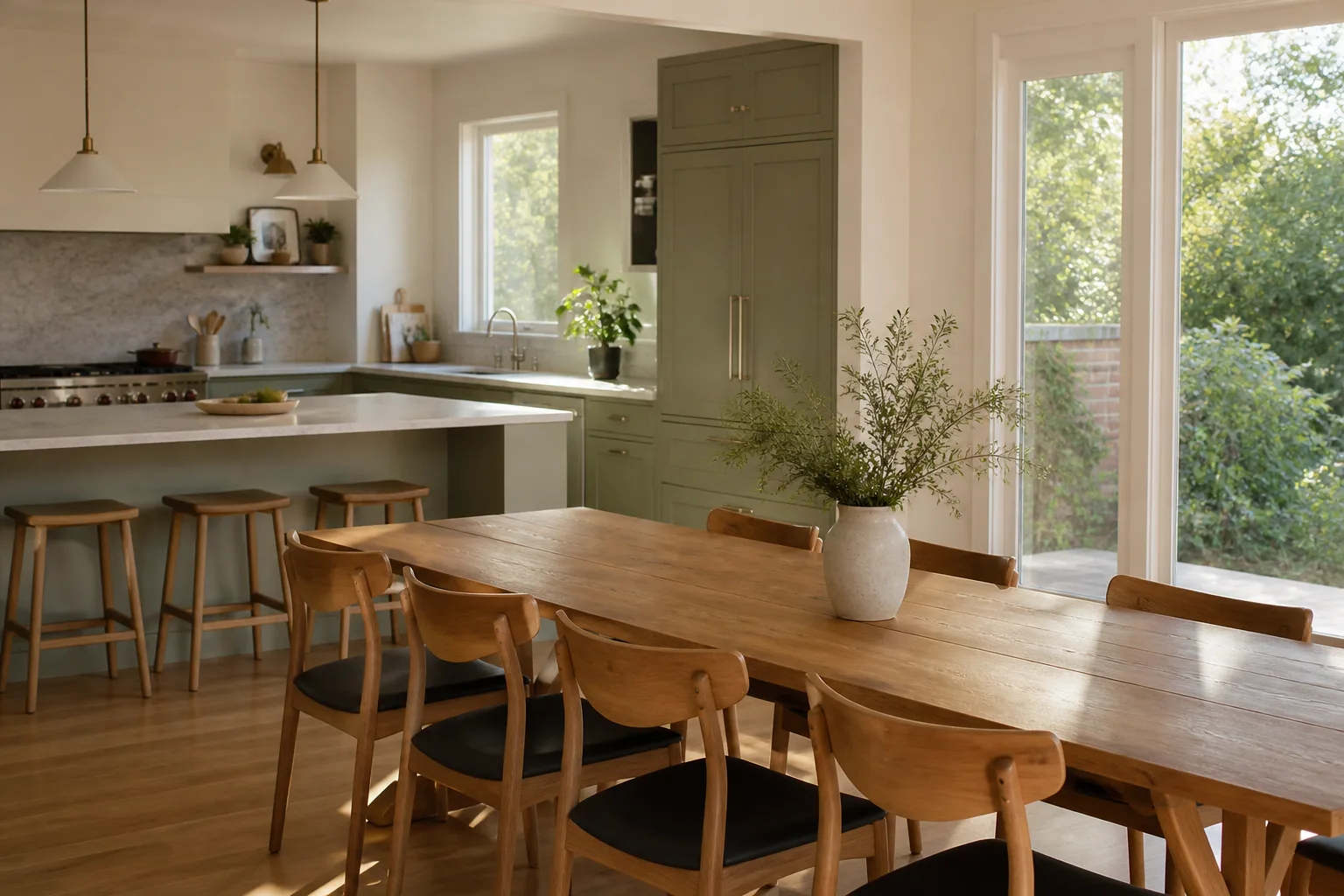
A written Cambria price should name templating, substrate and cabinet support, seam placement, perimeter caulk joint specification, and cutout reinforcement as line items, because a verbal quote almost always rolls those into a single “countertop installation” number and then omits them when the crew is under time pressure. That’s the gap the written price is designed to close.
Here’s a rough line-item breakdown of what a Cambria project in Mesquite typically involves. These are ranges, and the actual number depends on square footage, edge profile, and cabinet condition:
| Line item | Typical range (Mesquite, NV) |
|---|---|
| Cambria slab material (per sq ft, installed) | $75 – $110 |
| Templating and digital measurement | $200 – $400 |
| Substrate leveling and cabinet shimming | $150 – $500 |
| Corbels or steel support for overhangs | $200 – $600 |
| Fabrication and seam epoxy (color-matched) | Included in slab price typically |
| Perimeter caulk and backsplash joint | $100 – $250 |
| Sink and cooktop cutout reinforcement | $100 – $300 |
A verbal quote usually folds the middle three rows into the slab price or drops them entirely. The written price names them so you can see what you’re actually paying for and hold the crew to it. Our General Contractor in Mesquite page explains how the written-price promise works across every project type we take on, and our Elmstead Remodeling Mesquite home page is the place to start if you’re early in the process.
When to Call a Pro
If your Cambria installation involves an island overhang beyond a foot, a sink or cooktop cutout within six inches of a seam, or cabinets that aren’t perfectly level, it’s time to call a pro rather than work with a fabricator who quotes only the slab. Those three conditions are where we see the vast majority of warranty claims. Also call a pro if you’ve been quoted a verbal price and can’t get the seam placement in writing. That’s not a red flag you can negotiate away later; it’s a scope problem before the first slab is cut.
For a bathroom vanity in Cambria, the same substrate and seam rules apply at a smaller scale. Our Bathroom Remodeling in Mesquite page covers how we handle vanities and wet-area quartz.
The Bottom Line
Cambria is a good product with a real warranty, but the warranty only works if the installation meets the spec, and the only way to verify that is to put the spec in writing before templating. Ask about substrate flatness, seam placement, cabinet anchoring, and perimeter caulk joints. If a contractor can’t answer those four questions with specifics rather than confidence, the Cambria slab is going to be an expensive callback waiting to happen.
If you’re in Mesquite and need help, Elmstead Remodeling Mesquite offers free estimates. Our technicians have up to 21 years of experience, and we send them background-checked and uniformed on every job. We put a written price in front of you before any work starts, we lay drop cloths and wear shoe covers inside the house, and we take a photo of the clean-up before the crew leaves so you have proof the home was left right. Every project is covered by the 365-Day Done Right Promise, and the phone is answered by a live person, not a voicemail box. Call (833) 620-6606 to schedule your free estimate.
Frequently Asked Questions
Usually not if the crack is caused by installation, such as a seam placed over an unsupported span or a cutout placed too close to a seam. Cambria’s warranty covers manufacturing defects in the slab itself, and installation-related failures are evaluated separately. The best protection is a written scope that specifies seam placement and support structure before fabrication begins. Call (833) 620-6606 for a free estimate that includes seam documentation.
Cambria quartz typically runs $75 – $110 per square foot installed in the Mesquite market, with templating, substrate leveling, and support structure adding $650 – $1,800 on top depending on the project. The total for a typical Mesquite kitchen lands between $4,500 and $9,000 for the countertop portion alone. Call (833) 620-6606 for an exact quote, and the estimate is free.
Not with a written price. A written price is given before any work starts and covers templating, substrate preparation, seam placement, and support structure as named line items. A verbal estimate that omits those items is the one that grows after the crew arrives. If you’ve been quoted verbally, ask for it in writing before signing. Call (833) 620-6606 to schedule a free written estimate.
Templating takes one visit, fabrication typically takes seven to ten business days, and installation is usually a single day once the slab is fabricated and supports are in place. Cabinets and substrate prep must be finished and level before templating begins, so the cabinet work is often the longer part of the schedule. Call (833) 620-6606 to talk through your timeline and get a free estimate.
Written by the team at Elmstead Remodeling Mesquite.
Need Construction Help?
Call Elmstead Remodeling Mesquite - the local pro we connect you with is licensed and insured, here with fast after-hours help in Mesquite.
(833) 620-6606